
By The Public Communications Office
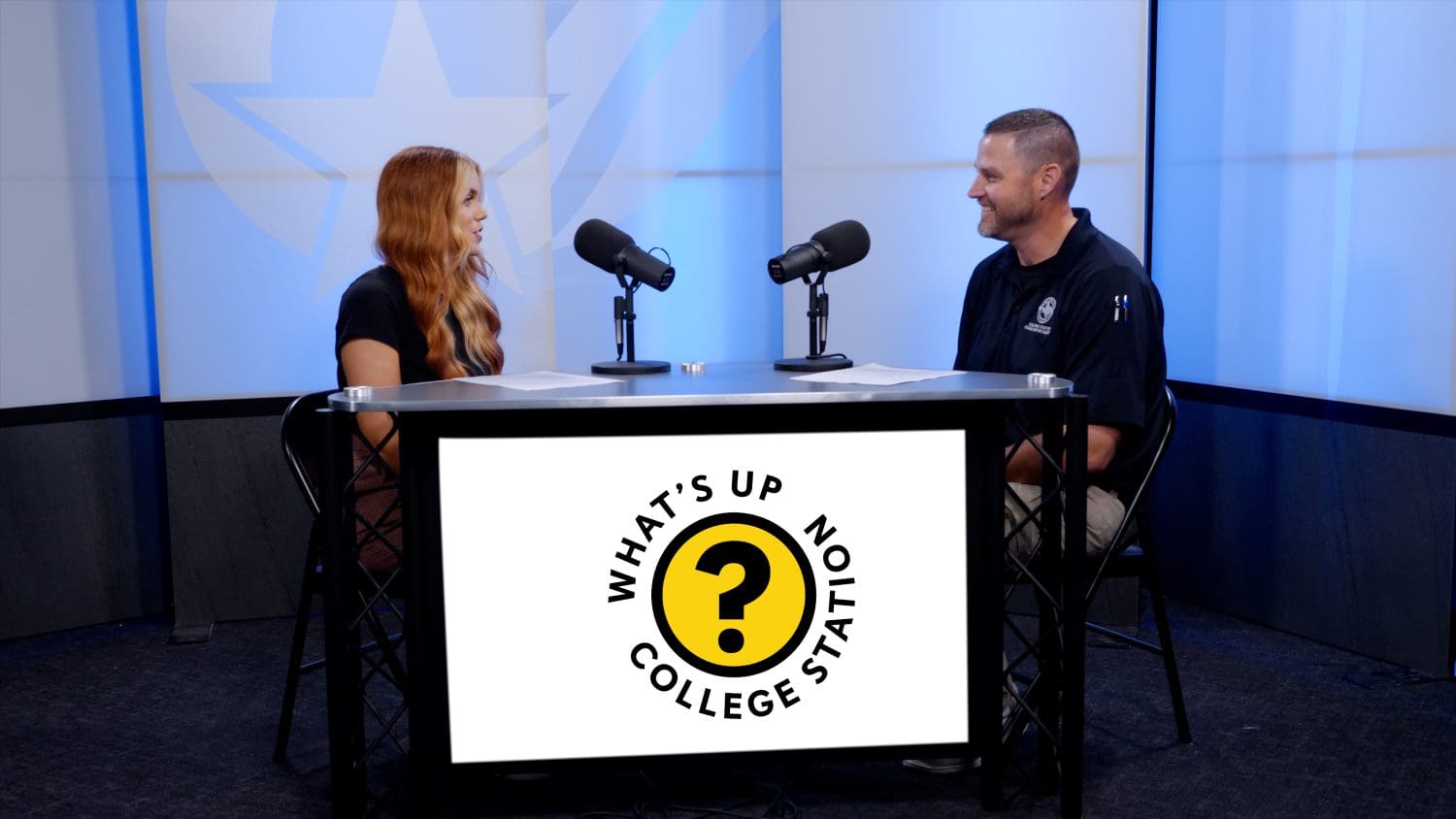
In this episode of “What’s Up, College Station?” Marketing Coordinator Grace Hallowell and Code Enforcement Supervisor Tommy Shilling discuss the over occupancy ordinance. They explore its history, penalties, and the renewal of enforcement starting June 1.
Download Podcast
Previous Episodes
Transcript
Grace Hallowell:
What’s up, College Station? I’m Grace Hallowell, and today I’m joined by Tommy Shilling, our code enforcement supervisor. Hi, Tommy.
Tommy Shilling:
Hello. Thanks for having me.
Grace Hallowell:
You’re welcome. I feel like we just saw you a week or so ago, but you always have some good information for us to share that sometimes people don’t know about or don’t know where to find this information. And this topic is kind of been a hot topic over the last few months, but it is the over-occupancy with the More Than Four.
Tommy Shilling:
Yes, ma’am.
Grace Hallowell:
So let’s kind of start off with what does that mean? What is it? Kind of a brief history of it, because it’s been in effect for years and years now.
Tommy Shilling:
Yes, yes. Actually, this ordinance was in effect back in 1939. It’s something that’s not new. So the way the over-occupancy, or the More Than Four is what we call it, you can’t have more than four unrelated people living in a single-family dwelling. Now if you have a brother or sister, that count as one person, but then you can only have three other roommates. So what we started to see was these five-plus bed and bath parities have more than five to six unrelated people. Last year, or two years ago, we amped up our enforcement on the More Than Four, and kind of had a success rate where we got that information out. “Hey, I know this is an ordinance that we really haven’t enforced for a while, or kind of more reactively.” So we kind of got that in the spotlight.
Grace Hallowell:
Yes. So this is a good topic to talk about today, because enforcement for this does start soon.
Tommy Shilling:
Yes. It actually starts June 1st. So code enforcement will proactively and reactively start enforcing this over-occupancy ordinance.
Grace Hallowell:
So, again, no more than four unrelated people are allowed to live in a single-family dwelling. And the key word there is single-family dwelling. If it is a multifamily unit, that is okay
Tommy Shilling:
In some parts. Yes.
Grace Hallowell:
In some parts of the city. Yeah.
Tommy Shilling:
Yes.
Grace Hallowell:
So you guys have been doing, as well as A&M, there’s been a lot of outreach and education happening about this rule. But, again, some people might not have heard. So how will this violation be enforced if somebody were to receive a citation for this?
Tommy Shilling:
Okay. Previously, before, on April 24th, our council actually was able to push this ordinance through, we enforced criminally. So with this new ordinance, the over-occupancy ordinance, we can actually enforce it civilly. So we can drive by certain areas, knock on doors, have conversations with people. It’s a good tool that we have in our toolbox now. So we can actually, depending on the severity, we can go after civil or criminal.
Grace Hallowell:
And what is the penalty or the fine? What does that look like for this violation?
Tommy Shilling:
First offense is 250, second offense is 350, and the third offense is 500. Now I will tell you this, it could be daily, but that’s dependent on staff, if we have available staff that we can do that enforcement piece.
Grace Hallowell:
So, it’s crucial for if you’re assigning a lease or looking to rent an apartment here in College Station that you read it very, very carefully. And y’all community services and code enforcement can help with that too if you have questions, right?
Tommy Shilling:
Yes, absolutely. Also, not just code enforcement or community services. You can call Texas A&M. Their campus student services have been great to work with. They ran the Me Plus Three campaign. We’ve done a lot of walk-and-talks in targeted areas. We give out gift bags and educational information letting you know, “Hey, this is going live June 1st, so please make sure, make sure, before you sign leases, that you’re not a ghost tenant. Make sure your name is on that lease, because you could receive a citation.”
Grace Hallowell:
Yes. And let’s kind of define what a ghost tenant is, for those who don’t know.
Tommy Shilling:
Right. Okay. So a ghost tenant is, like I said, please make sure that your names are on the lease.
Grace Hallowell:
Yes.
Tommy Shilling:
What we kind of learned the past two years is somebody could be not on the lease, and that’s what is considered a ghost tenant. So you would pay your rent through an anonymous person or anything like that. So please make sure your name’s on the lease, because that is a document and if we found out you are a ghost tenant, we will be knocking on your door for an investigation.
Grace Hallowell:
Right, right. So is there going to be a grace period for this enforcement?
Tommy Shilling:
It’s a case-by-case basis. So as of right now, the direction that we were given, June 1st, we go. I think the city has done their due diligence to get that information out. And the direction we were given is we start June 1st.
Grace Hallowell:
And let’s kind of talk about why this ordinance exists, why it’s important, because I know a lot of people might think, “Oh, I’ve never seen this at anywhere else that I’ve lived. Why is this a thing?”
Tommy Shilling:
Well, it’s a thing in a lot of places. It’s not just College Station. So some of our surrounding cities have the same ordinance. It’s very important because it helps alleviate excess parking on the street. It’ll help with accumulation of trash, parking issues, loud party reports. That’s kind of what drew this whole More Than Four ordinance, because we started to see a lot of stuff that’s going on in these neighborhoods, especially when it’s a heavy rental property.
Grace Hallowell:
Right. And sometimes you don’t always think that we are a college town, College Station. College is in our name, but there are also families here and there’s retirees here. It’s a good mix of multiple different walks of life. So we’re trying to make a cohesive environment for everybody who lives here.
Tommy Shilling:
Yes, we preach, “Be a good neighbor.”
Grace Hallowell:
Yes.
Tommy Shilling:
Get to know your neighbors. Go have a conversation with them. If you’re going to have a party, go talk to them. Let them know. That way you can build these strong relationships, and then they won’t call the police on you. So it’s very important to be a good neighbor.
Grace Hallowell:
So how can those who are signing leases or those who may have already signed a lease, how can they avoid this problem?
Tommy Shilling:
They can actually, if they’re an A&M student, or blend, they can talk to legal aid. They can actually go and talk to Texas A&M. They can kind of help. I don’t know if they can get them out of their leases, but they can definitely help, because if they’re knowingly breaking ordinance, like I said, then we can go after them. But you can always call College Station before you sign leases, and then we can let you know if that’s zoned in that area that you can have the More Than Four.
Grace Hallowell:
And another good thing to bring up is what the definition of a family is. So I know during the community living course, you guys like to play a game on is this More Than Four?
Tommy Shilling:
Yes, yes.
Grace Hallowell:
And you’ll have an example of fraternity brothers and a cousin and a roommate and a boyfriend and girlfriend. So what constitutes as a family member?
Tommy Shilling:
I think it’s a blood relation.
Grace Hallowell:
Yes.
Tommy Shilling:
I think it’s adoption as well. But also, with the More Than Four, it can’t be sorority sisters or fraternity brothers. And the game that we do like to play in the community living course, it kind of gets students and other people’s… their minds kind of open to, “Hey, let’s think about this.” So if you have four fraternity brothers, they’re not actually related. They might be related with their fraternity, but not actual blood related. So say if you have two sisters, that’s one family unit, and then they can have three other people, they can live with them.
Grace Hallowell:
So I know this is a lot of information, it can sometimes be confusing. Where can people go to find out more information or if they have questions?
Tommy Shilling:
Like I said, you can always contact Code Enforcement, 979-764-6363. You can contact our Planning Development Services Department. You can contact Community Services. Like I said, we’re readily available to help in any way we possibly can.
Grace Hallowell:
Well, thank you so much for joining me again, Tommy.
Tommy Shilling:
Thank you.
Grace Hallowell:
And that’s what’s up.
If you liked this post, share it with the buttons below!
Leave a Reply