

By Richard Mann, College Station Fire Chief
In the early days of the fire service in the 1800s, firefighters would respond to fires with horse-drawn hose wagons and steamers. When the crew returned, they would detach the horses and push the equipment back into the station to prepare it for the next response.
Those of us in the fire service hold tradition in high regard and feel a deep connection to the firefighters who came before us. That’s why the College Station Fire Department and many departments around the country have ceremonial “push-ins” when placing new apparatus into service.
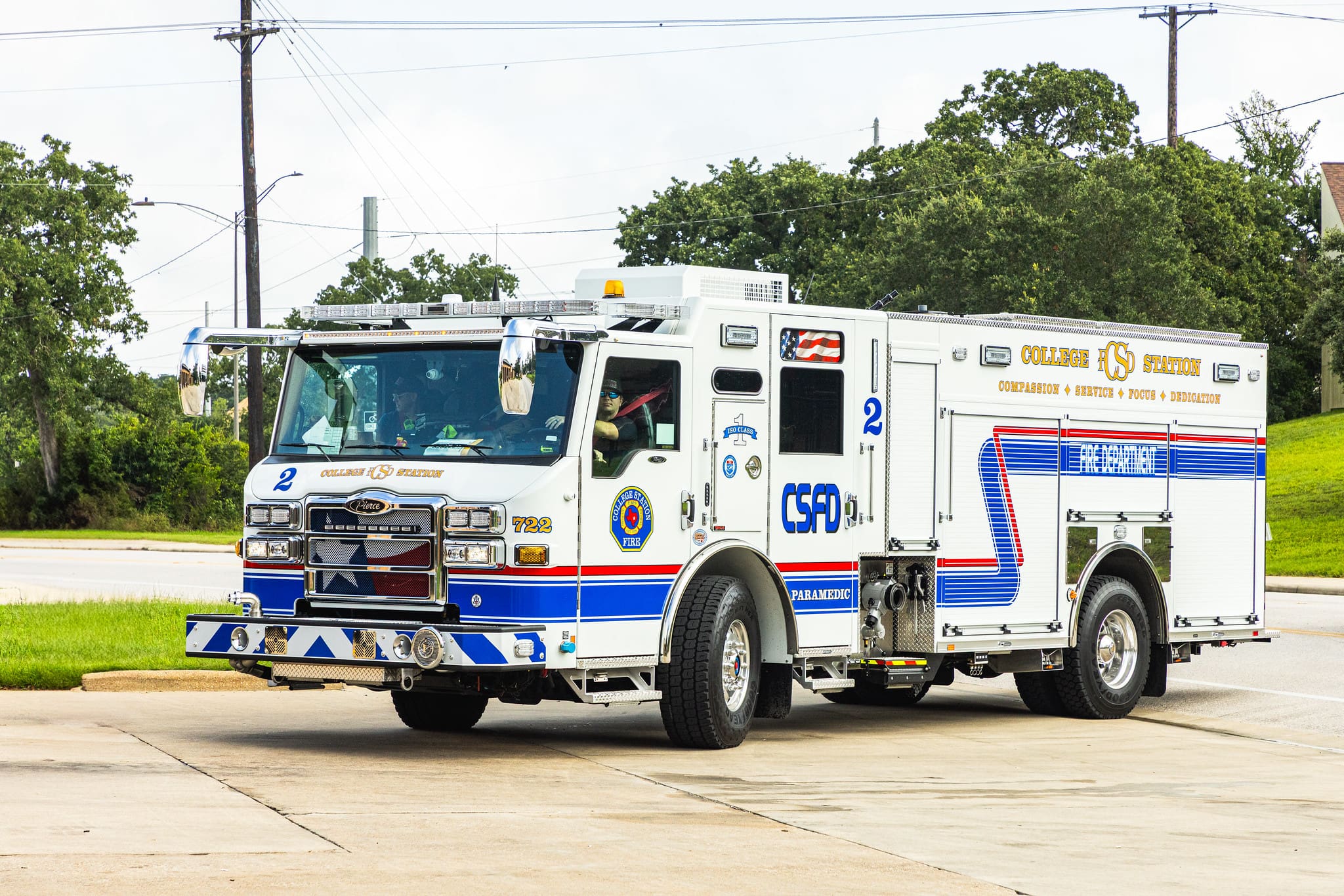
On Tuesday, the College Station Fire Department unveiled its two new state-of-the-art fire engines with a traditional “push-in” ceremony at Fire Station No. 2, marking the culmination of a process that began in 2021. Modern fire engines weigh about 50,000 lbs. – a bit more than horse-drawn wagons – so we can’t exactly push it in. Still, it bridges the past by symbolizing a new apparatus being positioned for the next call.
Our new fire engines represent a significant $2.2 million investment in the safety and well-being of College Station’s residents and visitors. Equipped with modern technology and equipment, the new all-hazard engines enable our firefighters and paramedics to respond safely and effectively to fires, EMS calls, specialty rescues, and hazardous materials (Hazmat) emergencies.
The engines replace a pair that have served our community since 2009 and will serve as frontline response units for the next 15 years before being placed into backup reserve status. Each engine is expected to respond to over 25,000 calls during its service life.
The engine for Fire Station No. 2 carries a 750-gallon water tank and a 1,500-gallon-per-minute pump capable of delivering water or firefighting foam and carries additional technical rescue equipment.
The engine for Station No. 5 carries a 1,000-gallon water tank and a 1,500-gallon-per-minute pump capable of delivering water or foam and features additional wildland firefighting equipment.
The new engines were ordered in April 2022, which demonstrates the industry challenges with extended lead times for apparatus replacement. We examined various apparatus styles and manufacturers to identify the best product and the best value to our community. The selection process led us back to Pierce Manufacturing, the same company that built the retired engines that have served us so well since 2009.
The engines were made possible through the support and collaborative efforts of the College Station City Council, City Management, Fleet Services, Siddons-Martin Emergency Group, and our internal apparatus design team.
Most importantly, we thank College Station taxpayers for providing the resources we need to fulfill our mission of protecting them, their families, and their businesses. We welcome community members to stop by Stations 2 and 5 anytime for a tour of your newest fire engines.
Of course, the most valuable equipment on these fire engines is the firefighters who stand ready to respond to emergencies 24 hours a day. Without their compassion, service, focus, and dedication, the fire engines would be just expensive ornaments.
I’m honored to work with these extraordinary professionals.

About the Blogger
Richard Mann has been College Station’s fire chief since 2020. He previously served for 31 years in the Houston Fire Department, honing his considerable leadership skills through large-scale emergency operations, including Hurricanes Ike and Harvey, as well as planning for major events such as Super Bowl LI. He earned a bachelor’s degree in fire and emergency services administration from Texas A&M-San Antonio and a master’s of public administration from Tarleton State.
If you liked this post, share it with the buttons below!
Leave a Reply