
Listen to the article
By Nicholas Barrio, Traffic Engineer
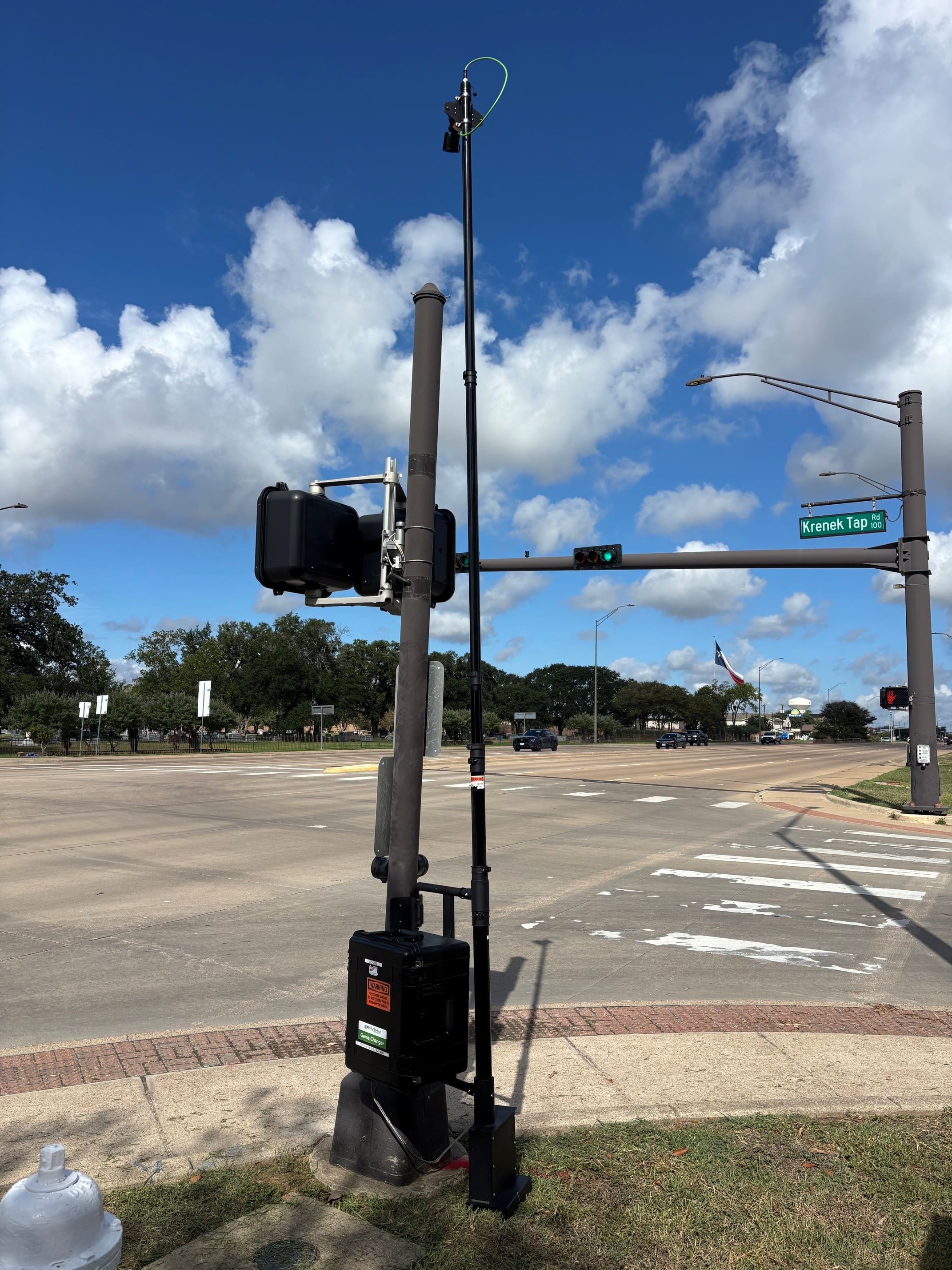
Have you ever noticed a small camera or radar unit attached to a pole or streetlight in your neighborhood and wondered about its purpose?
The City of College Station’s Traffic Engineering Division uses portable traffic-counting equipment throughout the city to better understand how vehicles, bicyclists and pedestrians use our streets. The data we collect helps our engineers evaluate traffic concerns, optimize signal timing, identify potential safety improvements and plan future transportation projects.
Note: These devices are NOT license plate readers, and they are not connected to any law enforcement surveillance network or police database. We want you to know exactly what our equipment is doing when you see it in your neighborhood.
For our traffic engineers, these devices are simply another tool that helps us understand what’s happening on our streets. The more accurate the information, the better the decisions we can make. Instead of guessing whether vehicles are speeding, how many cars use a roadway, or how pedestrians are moving through an intersection, we can collect real-world data and use it to determine what improvements may be needed.
Our goal is simple: safer streets, better traffic flow, and transportation decisions based on real data.
The two primary devices you may see around College Station are the Game|Changer traffic camera and the Traffic Data Collector radar unit. Both are temporary, non-permanent devices used strictly for traffic engineering studies.
Game|Changer Traffic Camera
The Game|Changer is a portable, pole-mounted traffic camera manufactured by Rhythm Engineering. Our staff installs these temporary units at intersections or along roadways to evaluate speeds and better understand traffic flow.
The camera lets us count vehicles, bicyclists, and pedestrians and identify general movement patterns, such as how many vehicles travel straight or make left and right turns. That information gives our engineers a clearer picture of what is happening in the field, rather than relying on observations or assumptions.
We can use the data to develop or adjust signal timing plans, evaluate intersections and corridors, respond to traffic concerns, and identify locations where safety or operational improvements may be beneficial.
| What it collects | What it DOES NOT do |
| Vehicle, bicyclist, and pedestrian counts | Does not capture or store license plate numbers |
| Turning and travel movements | Does not identify individual drivers or vehicle owners |
| General vehicle speeds | Is not connected to police or law enforcement networks |
| Traffic patterns at intersections and along corridors | Is not used for traffic enforcement or issuing tickets |
| Data to support signal timing and safety evaluations | Does not sell or disclose data to private companies |
Aggregate traffic counts (anonymous group data) may be shared with transportation planning partners, such as TxDOT or the Bryan/College Station Metropolitan Planning Organization, to assist broader infrastructure planning.
The unit is battery-powered and requires no permanent wiring, so our team can easily relocate it. A device typically stays in one area for 1-2 weeks before moving to the next study location.
Traffic Data Collector
The Traffic Data Collector, manufactured by Stalker Radar, uses radar technology to analyze speed and traffic volume. This device does not contain a camera.
These units are especially helpful when evaluating neighborhood requests for traffic-calming measures or investigating speeding concerns.
| What it collects | What it DOES NOT do |
|---|---|
| Vehicle speeds via radar | Does not record photographs or video (it has no camera) |
| Overall traffic volume | Does not record license plates |
| General vehicle classifications (passenger cars, large trucks, etc.) | Does not identify individual vehicles or drivers |
| Data to support speed limits, traffic-calming requests, corridor planning, and roadway studies | Is not used for traffic enforcement or issuing tickets |
The City’s Traffic Engineering Division uses the collected information only for engineering and planning purposes. As with our other traffic-counting equipment, we may also share aggregate data with transportation planning partners such as TxDOT and the Bryan/College Station MPO.
Comparison/Summary
| Game|Changer | Traffic Data Collector | |
| Manufacturer | Rhythm Engineering | Stalker Radar |
| Technology | Video-based traffic analysis | Radar |
| Measures | Vehicles, bikes, pedestrians, movements and traffic patterns | Vehicle speeds, volumes and general classifications |
| Has a camera? | Yes | No |
| Collects license plates? | No | No |
| Identifies drivers? | No | No |
| Used for enforcement? | No | No |
| Primary use | Signal timing, intersection and corridor studies | Speed studies and traffic calming evaluations |
| Shared with law enforcement? | No | No |
| Shared with transportation planning agencies? | Aggregate traffic data only | Aggregate traffic data only |
If you have questions about traffic-counting equipment, please contact the Traffic Engineering Division at traffic@cstx.gov or 979-764-3690.

About the Blogger
Nicholas Barrio is in his second year as a traffic engineer with the City. He previously worked for the U.S. Department of Defense, specializing in transportation systems around the world. An El Paso native, Nicholas earned bachelor’s (2020) and master’s (2025) degrees in civil engineering from Texas A&M.
If you liked this post, please share it with the buttons below!
Leave a Reply