
Listen to the article
By Colin Killian, Public Communications Director
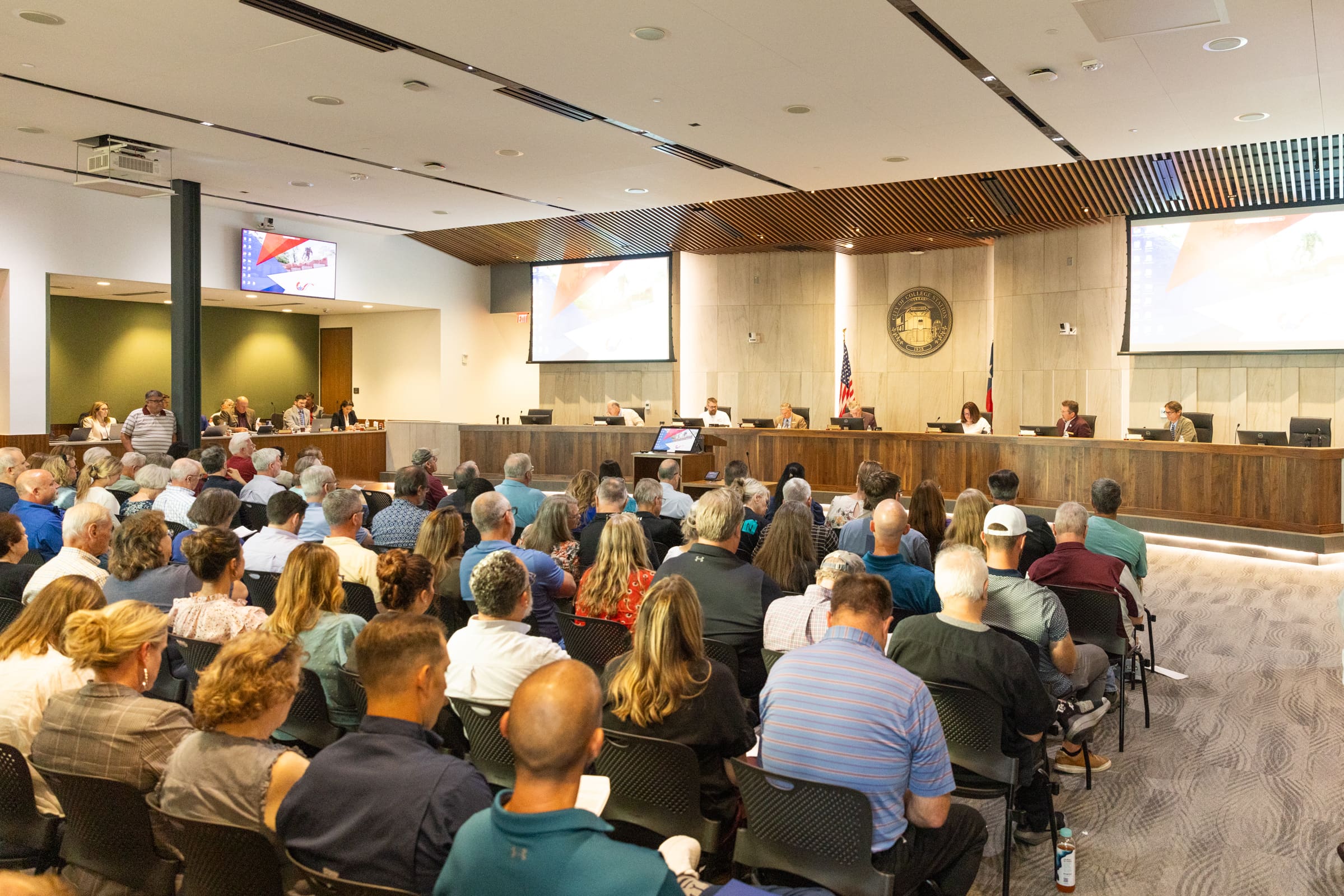
In case you missed it: At its Sept. 10 meeting, the College Station City Council discussed the anticipated impact of the Terafab project in Grimes County and College Station’s readiness to address associated opportunities and challenges.
Chief Development Officer Michael Ostrowski’s presentation highlighted regional growth trends, development and infrastructure capacity, and housing needs.
Here’s a summary:
Key Demographics & Economic Scale
- Project Scope & Investment: The Terafab project represents a $17 billion Phase 1 investment, over $100 billion in total project investment, and a projected $2+ billion economic impact by 2038 across a 100-million-square-foot facility [01:24].
- Workforce & Construction: Agreements project 1,500 to 3,000 direct jobs (scaling to 6,000+ total direct, indirect, and induced jobs) alongside roughly 5,000 annual construction workers over a 10-to-11-year buildout [01:59].
- Growth Context: The project is layering into College Station’s steady 2–3% annual population growth, which has historically been driven by Texas A&M enrollment [03:16].
- Local Zip Code Impact: Zip code 77845 in South College Station is projected to absorb the highest proportion of resident growth from direct and indirect jobs [06:28].
Infrastructure & Land Readiness
- Land Availability: The area features ~7,000 acres of developable land east of city limits and several hundred acres of vacant commercial and business center land inside the city [08:48].
- Transportation: Key corridors like W.D. Fitch Parkway currently operate at ~40% capacity and are expected to reach ~60% under a 3,000-job model, leaving solid remaining capacity [09:59].
- Utilities: Service territories east of the city limits are split between Bryan Texas Utilities (BTU), Wellborn Special Utility District, and Wickson Creek Special Utility District [11:08].
- Housing Pipeline: The active single-family and multi-family housing pipeline includes nearly 11,000 planned units (~28,000 resident capacity), providing sufficient space to absorb growth [12:04].
Case Studies & Regional Lessons
- Starbase (Brownsville): Showed how a major facility outside city limits shifts housing, rental, infrastructure, and tourism impacts regionally rather than confining them to a single host city [13:32].
- Samsung Fab (Taylor): Highlighted massive temporary construction workforce demands (~9,000 workers annually), heavy localized retail/restaurant spending, and ecosystem expansion [17:41].
Opportunities, Challenges & Council Q&A
- Economic Opportunities: Promotes economic diversification beyond higher education, boosts local sales tax spending, and raises the region’s national industrial profile [23:34].
- Key Challenges: Early lodging shortages due to construction workers, potential construction cost inflation on municipal projects, wage competition for specialized labor, and service demands outside city jurisdiction [31:31].
- Council Discussion: Councilmembers discussed construction timelines, non-tariff business inquiries picking up, long-term housing absorption, and the need for regional interlocal agreements [35:05].

About the Blogger
Colin Killian has been with the City of College Station since 2010 after serving 23 years as the associate media relations director for the Texas A&M Athletics Department. He has also worked as a reporter and editor for the Corpus Christi Caller-Times and Lewisville News. A native of Hobbs, N.M., Killian graduated from Texas Tech with a bachelor’s degree in journalism/political science.
If you liked this post, share it with the buttons below!
Leave a Reply