
Listen to the article
By Heather Wade, Principal Planner
What should the Harvey District keep? What needs to change? And what could make the area a better place to live, work, shop, visit, and spend time?
Over the past several months, the City of College Station invited residents, businesses, property owners, students and other community members to help answer those questions as part of the Harvey District planning process.
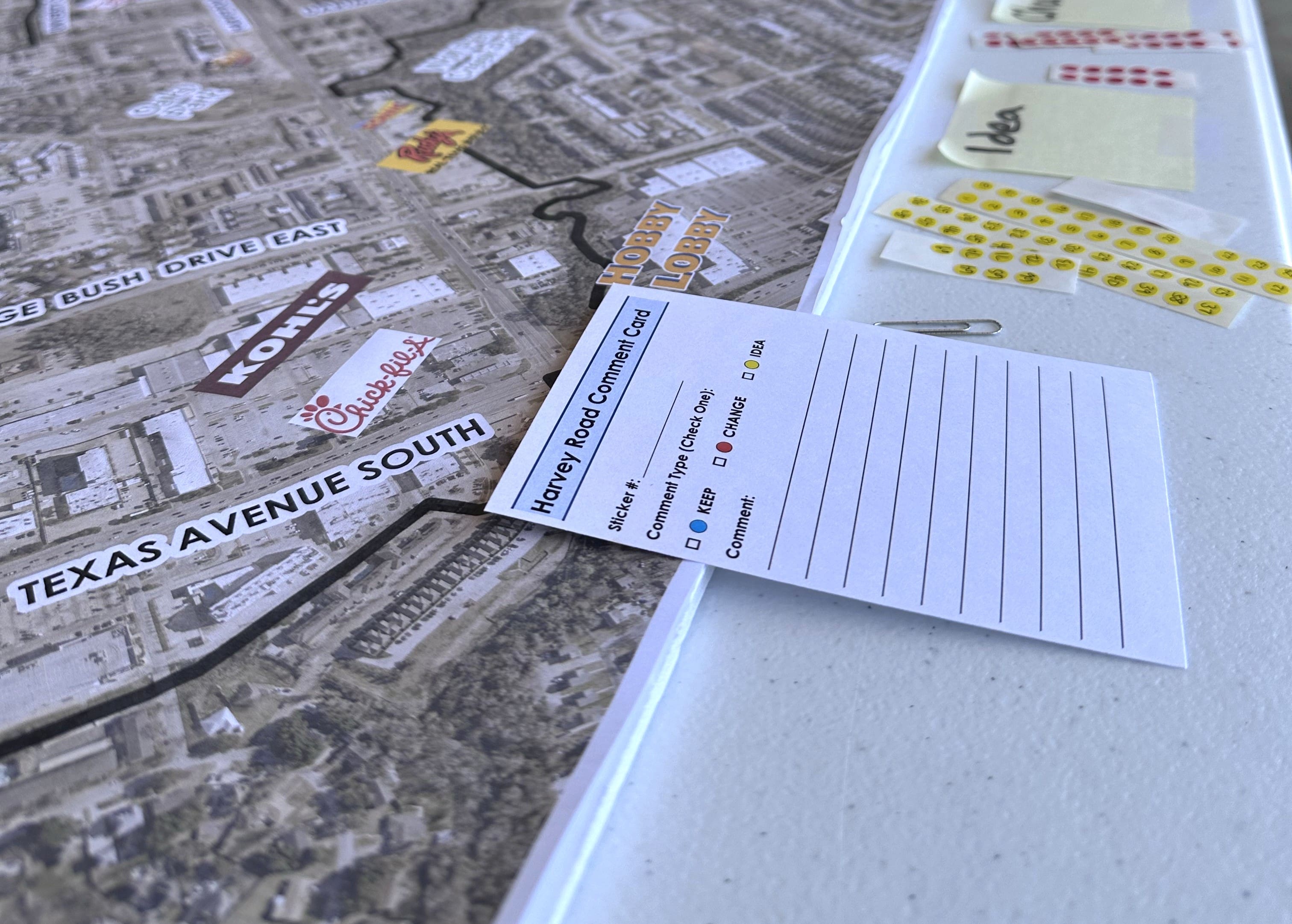
Community members shared input through a public open house, an online survey and interactive map, four visioning workshops, pop-up events throughout the district, comment cards and social media. Each engagement opportunity reached a somewhat different audience and offered a different way to participate.

While the input does not represent a scientific sample or point to one preferred redevelopment concept, several themes appeared consistently across the engagement activities.
Value and Untapped Potential
Participants described the Harvey District as centrally located and convenient, with valued businesses, established neighborhoods, housing choices, parks, trails and easy access to other parts of College Station. At the same time, many believe the district is not reaching its full potential.
Of the 265 people who completed the community survey, 52% rated the district as fair, while 34% rated it as poor or very poor. Aging buildings, dated appearances, vacant properties, large parking areas and the condition of Post Oak Mall were among the most frequently identified concerns.
Participants generally did not call for the district to be completely remade. Instead, they wanted thoughtful reinvestment that improves aging and underused areas while retaining the places, businesses, housing options and natural features people already value.
More Reasons to Visit
Existing businesses, particularly locally valued restaurants, shops, and services, were repeatedly identified as important parts of the Harvey District’s identity. At the kickoff open house, supporting local businesses received more priority votes than any other topic.
Participants also want a broader mix of shopping, dining, entertainment, recreation and community gathering opportunities. In the community survey, 59% of respondents said they would like the district to become a vibrant mixed-use destination, and 48% selected a more attractive and welcoming gateway into the city.
The feedback suggests that participants want the Harvey District to function as more than a corridor people travel through. They envision a place where people can meet, eat, shop, recreate, attend events and spend time throughout the day.

Reimagine Post Oak Mall and More
Post Oak Mall emerged as one of the district’s most significant opportunities across nearly every engagement activity. Participants offered a wide range of ideas, including renovating and reactivating the mall, introducing mixed-use development, adding restaurants and entertainment, creating community or event spaces, reducing large expanses of surface parking and improving connections to Wolf Pen Creek.
These ideas do not reflect agreement on a single future for the mall. They do, however, demonstrate strong interest in exploring how the mall and surrounding properties could become more active, attractive, connected and useful to the broader community over time.
Easier to Get Around
Walking, bicycling, traffic and access were among the most consistent, and sometimes most debated, topics. Participants frequently identified missing sidewalks, uncomfortable crossings, limited bicycle connections, gaps between destinations and a lack of shade along walking routes.
Suggested improvements included continuous sidewalks, safer crossings, protected bicycle facilities, multi-use paths, stronger connections to parks and trails and improved access to transit.
Traffic operations generated more varied opinions. Some survey respondents said medians and turn restrictions help traffic move more safely, while others said they make businesses difficult to reach and require inconvenient U-turns. Participants also raised concerns about particular intersections, traffic queues, access from Highway 6 and limited connections between adjoining shopping centers.
Rather than pointing to a corridor-wide solution, the input suggests evaluating access and traffic conditions at specific intersections and properties.

Parks, Trails and Green Space
Wolf Pen Creek, Oaks Park, adjacent neighborhood parks, trails, mature trees and natural areas were among the district’s most consistently valued features. Participants asked the City to protect and build upon those assets by improving trail connections, adding trees and landscaping, creating more shade, reducing unnecessary paved surfaces and integrating parks and green infrastructure into future development.
In the community survey, 50% of respondents wanted more green space or trails, while 43% identified additional trees and landscaping as an improvement that could make a significant difference. Participants often connected greenery with more than appearance. Trees, shade, parks and trails were also associated with comfort, recreation, resilience, community identity and easier access to walking and outdoor time.
Improve Housing and Affordability
Housing feedback reflected both a desire for improvement and concern about the possible effects of redevelopment. Participants raised issues related to the condition, maintenance, management and perceived safety of some older apartment properties.
At the same time, many recognized that the district provides comparatively affordable housing and cautioned against improvements that could displace current residents or eliminate lower-cost options.
The resulting message is nuanced: participants want safer, better-maintained housing, but they also want the planning process to consider affordability, displacement and the needs of people who already live in the district.
A District for Everyone
Across the engagement results, participants asked for places and activities serving people of different ages, incomes, backgrounds and abilities. Ideas included family activities, youth recreation, community events, senior-friendly destinations, accessible public spaces, arts and entertainment, pet-friendly places and gathering spaces connected to parks and businesses.
Participants also emphasized that the Harvey District is home to a diverse community, including residents who may be less likely to participate in traditional planning processes. Reaching renters, students, younger adults, business and property owners, and people who live and work within the district will remain important as the planning process continues.

What Happens Next?
Community input is helping the project team identify the choices and trade-offs to explore during the next phase of the Harvey District Plan. The city will use the engagement results, along with technical analysis, market findings, adopted plans, and guidance from the Harvey District Working Group to develop and evaluate possible future scenarios.
Those scenarios will help the community consider how different approaches could affect development, housing, transportation, businesses, parks, public spaces and the district’s overall character.
The input received so far does not serve as a final recommendation or decision. Instead, it provides a foundation for continued discussion about how the Harvey District can evolve while building on the qualities that already make it an important part of College Station.
To review the complete engagement summaries and learn about upcoming opportunities to participate, visit cstx.gov/HarveyRoad.

About the Blogger
A certified public planner, Heather Wade is in her third year as the City’s principal planner. She previously served as a community engagement specialist and researcher at Texas A&M and worked in planning for the Oregon Department of Land Conservation and Development and Texas Sea Grant. Heather earned three degrees from Texas A&M – a bachelor’s in environmental studies, a master’s in urban planning, and a doctorate in urban and regional science.
If you liked this post, please share it!
Leave a Reply